


Widespread Disruption as Google Cloud Outage Hits Spotify, Healthcare, OpenAI and More
On June 12, 2025, a significant Google Cloud Platform (GCP) outage disrupted digital services worldwide, affecting businesses, healthcare systems, and popular online platforms like Spotify, Discord, and OpenAI. The outage began at approximately 11:46 AM PDT (2:46 PM EDT) on June 12, 2025, when Google Cloud’s Identity and Access Management (IAM) and storage systems started failing. By 12:30 PM PDT, cascading effects were reported across multiple services, with peak disruptions occurring between 1:00 PM and 2:00 PM PDT. Google’s official status page confirmed a seven-hour disruption, with most services restored by 6:00 PM PDT, except for lingering issues in the us-central1 region.
Key Timeline of Events
-
11:46 AM PDT: Initial failures in GCP’s IAM and storage systems.
-
12:30 PM PDT: Cloudflare reports outages due to Google Cloud dependency.
-
1:00–2:00 PM PDT: Widespread disruptions peak, affecting over 13,000 users, as reported by Downdetector.
-
3:29 PM PDT: Google identifies the root cause and applies mitigations.
-
6:00 PM PDT: Most services are restored globally, with us-central1 partially recovered.
-
June 13, 2025: Full recovery announced, with Google promising a detailed post-mortem.
According to Google’s preliminary incident report, the outage stemmed from a failure in the Google Cloud API management platform. A new Service Control feature, introduced on May 29, 2025, for quota policy checks, lacked proper error handling and feature flagging. This led to a null pointer error crashing a binary when reading empty fields from Spanner, Google’s distributed database. The remediation process triggered a “thundering herd” effect due to the absence of exponential backoff, requiring manual throttling to stabilize systems.
Google has acknowledged that inadequate testing and error-handling systems exacerbated the issue, highlighting a need for more robust deployment practices.
Read More: Amazon Refund Lawsuit Gains Traction
Services and Industries Impacted
The outage affected over 50 Google Cloud services, including critical components like Cloud Storage, BigQuery, App Engine, Vertex AI, and Google Workspace tools (e.g., Google Meet, Drive, and Documents). Third-party services dependent on Google Cloud, such as Cloudflare, Spotify, Discord, Snapchat, OpenAI, Shopify, GitHub, and Mailchimp, also experienced disruptions.
-
Business and Productivity:
-
Google Workspace outages disrupted remote work, with tools like Google Meet and Drive unavailable for hours.
-
E-commerce platforms like Shopify reported service interruptions, impacting online transactions.
-
-
Healthcare:
-
AI tools like Vertex AI Online Prediction and Dialogflow CX, used for patient diagnostics, were down for nearly four hours, affecting hospitals globally.
-
-
Entertainment and Social Media:
-
Spotify and Discord faced significant outages, with users unable to stream music or communicate.
-
Snapchat and other platforms reported intermittent failures.
-
-
Technology and Development:
-
Firebase, SSO, and login systems failed, disrupting developer workflows.
-
Cloudflare’s analytics and key-value services were impacted, affecting web security and content delivery.
-
The outage was global, with reports of disruptions in major cities like Mumbai, Delhi, and across the U.S. Downdetector logged over 13,000 incident reports in the U.S. alone, with additional spikes worldwide.
Financial and Reputational Impact
The outage posed a setback for Google Cloud, which competes with Amazon Web Services (AWS) and Microsoft Azure in the cloud infrastructure market. Alphabet’s stock ($GOOGL) and Cloudflare’s stock ($NET) fell by approximately 5% on June 12, reflecting investor concerns.
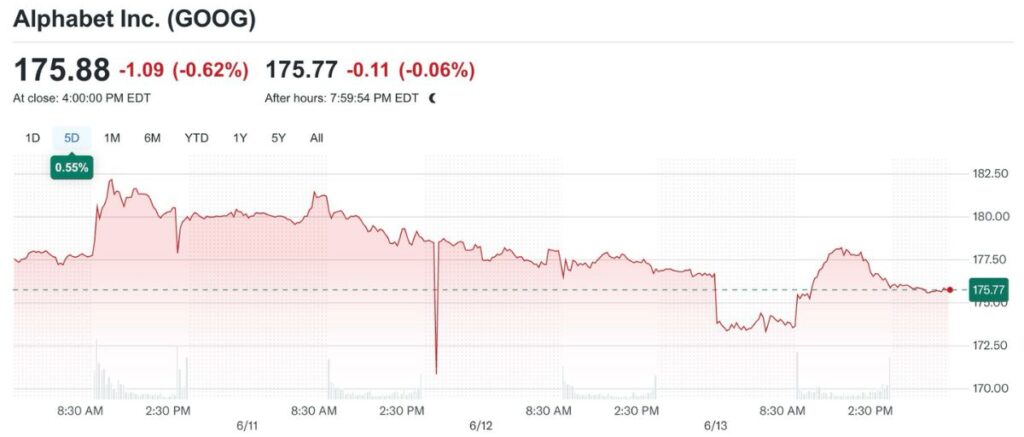
For businesses, the outage led to lost productivity and revenue, particularly for e-commerce and SaaS companies. In healthcare, the temporary loss of AI diagnostic tools raised concerns about patient care reliability. Google’s promise of a post-mortem report aims to rebuild trust, but the incident underscores the risks of over-reliance on a single cloud provider.
Lessons Learned and Best Practices
After covering numerous outages, and this incident, it highlights critical lessons for organizations:
-
Diversify Cloud Providers:
-
Relying solely on one provider, like Google Cloud, increases vulnerability. Multi-cloud or hybrid cloud strategies can mitigate risks.
-
-
Implement Robust Failover Systems:
-
Businesses should design applications with redundancy across regions or providers to ensure continuity during outages.
-
-
Test and Monitor Extensively:
-
Google’s lack of feature flagging and error handling underscores the need for rigorous testing before deploying updates.
-
-
Communicate Transparently:
-
Google’s status page updates were delayed, causing confusion. Real-time communication with customers is essential during incidents.
-
-
Plan for Disaster Recovery:
-
Organizations must have disaster recovery plans, including offline backups and alternative workflows, to handle prolonged outages.
-
Google’s Response and Next Steps
Google Cloud’s CEO, Thomas Kurian, issued a statement apologizing for the disruption and confirming full restoration across all regions and products by June 13, 2025. The company is conducting a thorough investigation and will publish a detailed post-mortem to outline preventive measures.
Google has also emphasized its commitment to improving service reliability, particularly as demand for AI-driven cloud services grows. However, this outage may prompt customers to reassess their dependency on GCP.
The June 2025 Google Cloud outage serves as a stark reminder of the fragility of cloud-dependent systems. As businesses, healthcare providers, and consumers increasingly rely on cloud infrastructure, a single point of failure can have far-reaching consequences. This incident wasn’t malicious, but its impact mirrored a large-scale cyberattack, highlighting the need for resilience in our digital ecosystem.
The Google Cloud outage of June 12, 2025, disrupted critical services worldwide, affecting industries from healthcare to entertainment. Caused by a flawed API management update, the incident exposed vulnerabilities in Google’s deployment processes and underscored the risks of cloud dependency. By adopting multi-cloud strategies, rigorous testing, and robust disaster recovery plans, organizations can better prepare for future disruptions.
About the Author: Aditi Sharma

Disclaimer
Techizta publishes content submitted by third-party agencies, partners, and clients. Any such posts are categorized and tagged accordingly:
- Sponsored Content: Posts labeled as "Sponsored" are paid placements submitted by third-party agencies or clients. Techizta does not endorse or express any views regarding the information contained in these posts. The opinions expressed belong solely to the respective authors and do not reflect the official policy or position of Techizta.
- Press Releases: Posts labeled as "Press Release" are paid PR submissions provided by our partners and clients. These are published as received and should be considered as promotional content.
The information provided in such posts is strictly for informational purposes only and should not be interpreted as buying recommendation, or professional advice. Techizta does not recommend, endorse, or promote any specific products, services, or companies mentioned. Readers are strongly encouraged to conduct independent research and consult with a qualified professional before making any decisions.
Additionally, all featured images accompanying such posts are intended as creative depictions of the subject matter. There is no intent to offend or misrepresent any individual, institution, or entity. If any content or imagery is found to be objectionable, please reach out to us at [email protected], and we will promptly review the concern.



Get Smart Insights In Inbox
Stay ahead of the curve with expert analysis and latest smart tech updates.
